Sunday, April 24, 2011

Parenting must include consequences...

Have you ever observed a parent that never let a child face the consequences of bad behavior? You can be absolutely sure of this, that child will grow into an immature and irresponsible adult. Our culture of entitlement has produced a spoiled generation of children who repeatedly have to be asked, “What do you say?” after receiving an expensive Christmas present. When you allow a child to go to jail and refuse to bail him or her out for driving one hundred miles an hour or doing drugs, that child learns to value a driver’s license or a safe environment.

When we have vague expectations and choices without consequences it leads to confusion. We see this in other arenas in the world. Politicians face serious consequences with their constituents when they commit moral failure. Athletes who break the rules, throw temper tantrums, or use drugs are often required to sit out entire seasons.

Why would a parent not require the same of their children? It is not love to always be rescuing your child from his or her own consequences of bad choices or behavior. It is just the opposite, it is a lack of love.

Scripture teaches: A hot-tempered person must pay the penalty; rescue them, and you will have to do it again. (Proverbs 19:19, NIV)

Allowing consequences to occur sends a message to the soul of the one involved. You are letting them know that no matter the amount of maneuvering they may try, you are letting them face the music because you don’t want to have to go through this scenario ever again with them. You can love, support, empathize, assist, and encourage…but you will not rescue them from the consequences.

This is what God did with Adam and Eve. Their wrong choice brought them death (Genesis 2:17) and expulsion from the Garden of Eden (Genesis 3:23). But even with the consequences of their behavior, God still showed them love and grace. He showed mercy to them by covering them with skins, but in no way did He change the consequences of their actions.

When you rescue your own child from a consequence that stemmed from a bad decision or behavior, you are interrupting the natural law of sowing and reaping. But the Bible is very clear that character change cannot occur without pain (Hebrews 12:11). A child who never feels the pain of wrong choices will repeat them every time.

Parenting isn’t easy. But the parent who doesn’t let their child face consequences is handicapping their child to a life of stunted maturity and constant frustration. But the parent who allows their child to face their own consequences will give them the best gift that can be given…love.

Monday, March 21, 2011

Rob Bell's got a hell of a problem...

On March 15th, Rob Bell's latest book Love Wins was released. Even before its release, the book created quite a bit of controversy. Well, what's the big deal? Rob Bell, the minister at Mars Hill Church in Grand Rapids, Michigan has always been known for being a little edgy and at times controversial.

Well, the big deal is the ideas being put forth in this book by Rob Bell. King Solomon wisely stated that "there is nothing new under the sun." (Ecclesiastes 1:9)and nothing could be more true of the teachings in Bell's new book. Bell even says this himself in the introduction to his book. He says, "...nothing in this book hasn't been taught, suggested, or celebrated by many before me. I haven't come up with a radical new teaching that's any kind of departure from what's been said an untold number of times."

Even though Rob Bell denies being a universalist that is precisely the doctrine he is espousing in his book.

I want to give you a break down of the book, chapter by chapter.

Chapter one was entitled, "What About The Flat Tire?"

In this chapter Bell simply asks a series of questions about doctrine. He doesn't provide any answers but questions he has. Lots of them. He asks about the doctrine of the age of accountability. He asks about the sinners prayer? He asks if all that matter is if we have a "personal relationship" with Jesus or not even though that phrase is not found in Scripture. (And in passing, he mentions that a woman authored the book of Hebrews - which for someone who seems to be so in tune with Jewish history, this is a real stretch to say the least.) He asks if what we say is what saves us? He asks if what we do is what saves us? He asks if it is who we forgive that saves us? He asks if it is the faith of our friends that saves us (Mark 2)? He asks if it is through childbearing that saves us (1 Timothy 2)?

As I said, no answers. Just questions.

Chapter two was entitled, "Here is the New There"

In this chapter Bell puts forth his belief about heaven. He recounts the story of the rich young ruler. Bell points out that the rich young ruler was not corrected by Jesus when he asked: What must I DO to get eternal life? Because most contemporary preachers would have pointed out to the rich young ruler you don't DO anything, you can't earn it. But instead, Jesus tells the man to obey the commandments and then to sell off all his possessions.

Bell teaches in this chapter that heaven is not a place we go to, it is a state of being that we are invited by God to participate in here and now. Unfortunately for Bell, Jesus does not teach this. Jesus spoke of going to his Father's house (John 14:1-4). In the book of Hebrews (authored by a man, by the way), the idea of heaven being a place is furthered by the teaching of heaven as the future "country" of the saints (Hebrews 11:16). In Philippians 3:2o Paul (another male) says that our "citizenship" is in this new country/place. The Bible describes heaven as a place in it's descriptions of heaven as a city (Hebrews 11:10; Hebrews 12:22; Revelation 21:2). The Bible does not support Bell's understanding of heaven being a state of mind that we are invited to participate in here and now. Heaven is the future home of the saints of God. It is a prepared PLACE for those who are prepared to go there.

Chapter three is aptly entitled, "Hell"

In this chapter, Bell recounts the story Jesus tells in Luke 16 of Lazarus and the rich man. Bell points out that the fact that the rich man asks for Lazarus to bring him water means he still desired for people to serve him. The rich man's "hell" was that he as in a lower status than Lazarus after death.

Bell spends a great deal of time in this chapter showing that God clearly punishes to reconcile. He points out that Sodom and Gomorrah are restored according to Ezekiel 16.

Bell teaches that ultimately hell is a metaphor to describe present-day evils much like (according to Bell) "Gehenna" [the dump outside of Jerusalem] was for Jesus in his day.

But Scriptures teach a different story again. The Scriptures teach that hell is a real place that was originally created for the devil and his angels (Matthew 25:41). The Bible teaches that those who reject God and do not obey the gospel will go there (2 Thessalonians 1:8-9; Revelation 20:15).

Chapter four is entitled, "Does God get what God wants?"

Bell quotes 1 Timothy 2:4 which states that God "wants all people to be saved and to come to a knowledge of the truth." Bell asks, "So does God get what He wants? Or does God fail in the end?"

Bell teaches that God will eventually win everyone over with his love, if not in this life, then after death. He espouses in this chapter that even the early church fathers held this view (which is historically inaccurate).

Bell concludes his chapter by saying, "Telling a story about a God who inflicts unrelenting punishment on people because they didn't do or say or believe the correct things in a brief window of time called life isn't a very good story."

Again, the word of God does not support any idea of a sinner's salvation after death. Instead, the male author of Hebrews clearly declares, "it is appointed for men to die once and after this comes judgment." (Hebrew 9:27) And, to be honest, I disagree with Bell, I think it is a good story. Because any story that's true is a good story.

Chapter five is entitled, "Dying to Live"

I really enjoyed the bulk of this chapter. Bell teaches about the resurrection and its implications for us in the here and now. I honestly didn't have much of a problem with this chapter at all.

Chapter six is entitled, "There are rocks everywhere"

In this chapter Bell amazingly tries to explain that when Jesus declares that He is "the way the truth and the life," No one comes to the Father except through him, that this is actually a very open statement of Jesus. Because Jesus doesn't explain the mechanism of how one gets to the Father through him. So this "opens the door to Muslims, Hindus, Buddhists, and Baptists from Cleveland." Bell says, "Jesus is as exclusive as himself and as inclusive as containing every single particle of creation."

Need I mention more about the absolute heretical thoughts Bell is trying to convey? Muslims do not accept Christ as the Son of God, yet Bell is saying that doesn't matter. A Hindu does not accept Christ as the Son of God. They believe that people who are economically depressed or diseased have had this happen to them because of some wrong they committed in a past life. A Buddhist does not believe Christ is the Son of God. But somehow all of these religions are equal?

It really is like a funnel, according to Bell. In the end, Jesus will funnel all to the Father, no matter what the believed or did.

This is blasphemous heresy.

Chapter seven is entitled, "The Good News is better than that"

In this chapter Bell tells the story of the two sons from Luke 15. He believes that story is a metaphor for how when we believe our own version of our life's story over God's version then we create hell here and now for ourselves. Bell says, "Hell is our refusal to trust God's retelling of our story." Bell believes that we actually shape God who in turn shapes us.

I don't give humanity that much credit. I am not a Calvinist, but the one point I would be most willing to accept is the depravity of man. We are fallen creatures with very little power. It seems that the gospel has man at the center doing a lot that makes God almost unnecessary according to Bell. I reject his view outright.

Chapter eight is entitled, "The end is here"

This chapter is a basic recap of the book.

Ultimately Bell is trying to rescue Christianity from itself. Bell attempts to reduce the Bible, and particularly, the Gospel to a story, and (as Albert Mohler points out) it is his duty to tell us which story is better than another. The problem is this...the church must tell one story. The story in the Bible, every Word of it. We do not get to choose what we think would be a more compelling story for an unbeliever.

We are compelled to preach the offensive message of the cross of Christ and any attempt to offer a story superior to the comprehensive story of the Bible fails on all fronts! It is an abdication of biblical authority, a denial of biblical truth, and a false Gospel. It misleads sinners and fails to save. It also fails in its central aim — to convince sinners to think better of God. The real Gospel is the Gospel that saves — the Gospel that must be heard and believed if sinners are to be saved.

In the end, Bell's book: Epic Fail!

Sunday, February 20, 2011

Real Men 2011

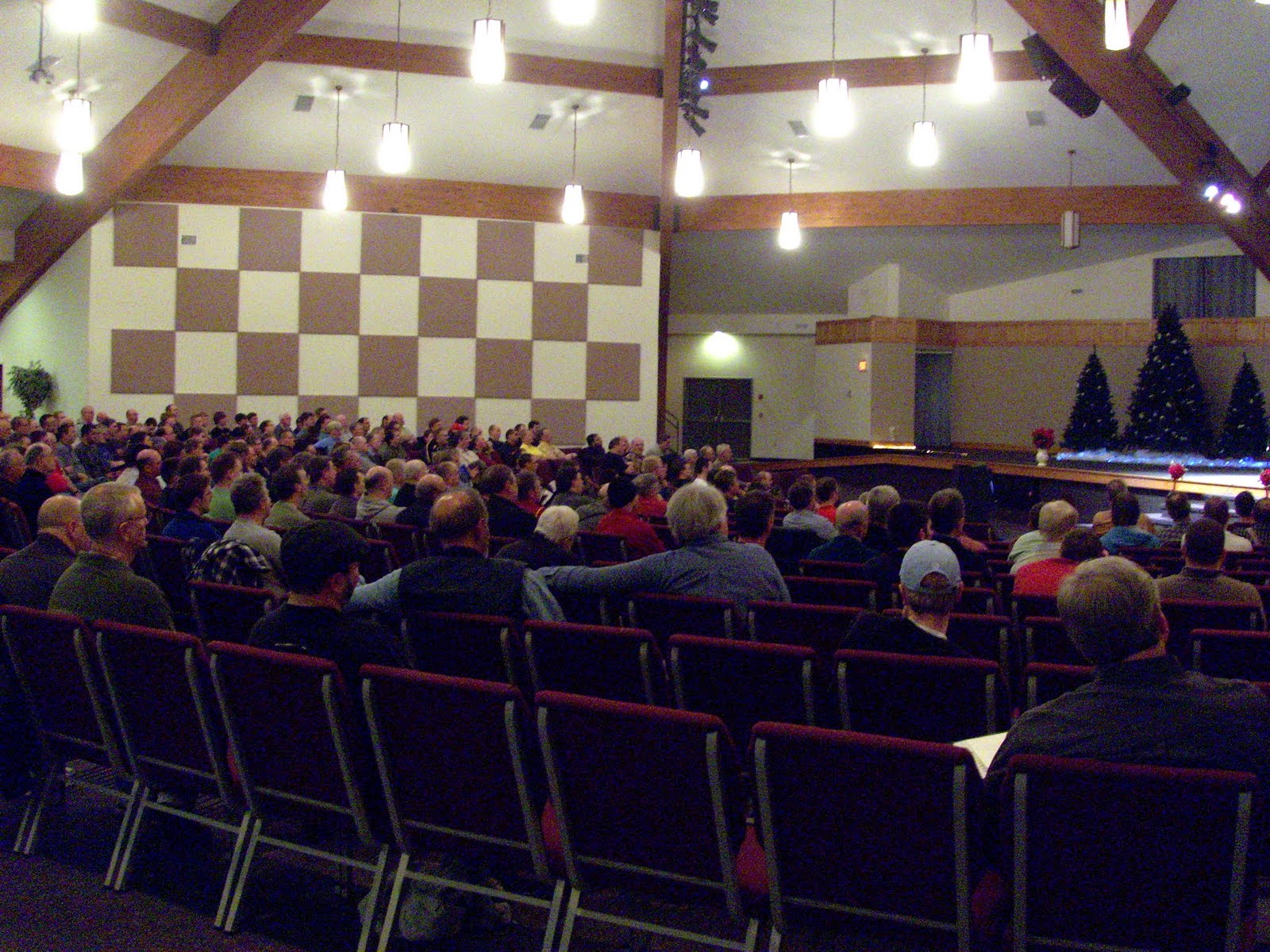
The Real Men Conference was held at Rising Sun Church of Christ on Friday night, February 18, 2011. 230 men came from all over the state of Iowa. 45 different Iowa communities were represented. It was an incredible encouragement to the men who came.

Pathway Band (from Pathway Church in Johnston, IA) led the worship experience. Hearing the room filled with men lifting their voices in praise to God was an incredible experience!

Jan Mickelson (from WHO Radio) spoke to the men about their relationship to the Lord as the primary factor in helping them become “Real Men” who will appropriately love their wives. It was a tremendous message that spoke straight into many of the men’s hearts

We watched the video testimony of Austen Arnaud (former quarterback for Iowa State) who shared the unique struggles and challenges of being a Christian athlete in an arena that is largely not Christian.

We also heard from Fred Stoeker (author of Every Man’s Battle) who shared his testimony. Although Fred went a little long, his message was a tremendously practical message calling men to live pure lives for the Lord and for the sake of the next generation.

Since the conference I have heard from a number of men who were impacted by the experience. Here’s a few examples:

I just wanted to thank you for sponsoring the Real Men Conference last night. I thought it was a blessed and successful event. God also helped me to leave a bunch of garbage at the altar. Thank you again. I can’t wait for the next one!” -Stewart

Awesome job on the Real Men 2011 -- I counted at least 15 of my guys there, which means you helped impact the families in our church in a very positive Godly way -- THANKS!” –Dan Hudson, Pathway Church

There have been more examples like these but I just wanted you to see a sampling. I am convinced that men are hungry for truth in this dark culture. Men need encouragement to be men. Men want to be called out to a higher standard than that of the world that says a real man drinks a lot of beer and ogles a lot of women. But a Real Man of God knows better.

That is why this conference is so important. I am so proud of Kyle Phillips who God laid the idea on his heart. He listened to God and now, as a result, many, many men’s lives have been impacted. Kyle Phillips is a Real Man!

Tuesday, February 8, 2011

Jan Mickelson, aka Jedi Master...

Maybe you saw the video of Zach Wahls giving his testimony speaking before a House Subcommittee on the marriage debate. If not here it is...


It was very well worded and presented. On Jan Mickelson's radio show today he masterfully "Reverse engineered" Zach's speech by deconstructing his arguments line by line. Here is the LINK to Jan's Blog on this. By the way, Jan Mickelson not only proves that he truly is the Jedi Master in this, he also happens to be one of the keynote speakers for our upcoming Real Men Conference on February 18, 2011 at Rising Sun Church of Christ. Register today at realmeniowa today!

Friday, February 4, 2011

Word Choices and Heart Matters

It isn't uncommon to hear Pro-lifers referred to as "anti-abortionists" by those in the media while those who support abortion are not referred to as "anti-life," they are simply "Pro-choice." Recently, Michael Reagan, was upset by those in the media who labeled him as a "conservative" radio talk show host, but in the same segment wouldn't describe his brother as a "liberal" talk show host when they were both being interviewed.

Dave Price is a local media personality that I like and respect, to be honest. I don't agree with him all of the time, but find him to be generally fair in his treatment of subjects, that is, until a very recent segment he did where he let his own liberal leanings show through.

He was covering the current debate in the Iowa State House over the marriage amendment. In his story, Price said that "Republicans were working to provide a more "narrow definition" of marriage in Iowa." I wrote to Dave Price and told him that I felt that his use of the phrase "narrow definition" was not only unfair but it was a revelation of where he actually stands on the issue. Of course, he defended his use of the term and wrote about it here.

Here's my contention with describing the Republican position as providing a "narrow definition" of marriage. Why not describe the Democrats as attempting to provide a more "broad definition" of marriage? That is exactly what is occurring, by the way. Republicans cannot provide a more narrow definition because the historical definition of marriage has always been a man and a woman for life. So in all actuality the Democrats are the ones trying to revise the definition of marriage.

Media personalities like Dave Price remind us from time to time that our words matter. The word choices we employ reveal our hearts. Christ Himself said, "What comes out of our mouth comes from our hearts." (Matthew 15:18) I believe that the majority of media personalities, including Dave Price, have liberal leanings and their word choices reveal what is really in their hearts concerning their true feelings on the subjects they cover.

Even though Dave Price may disagree, his heart was revealed this week in his word choice. He believes that the current redefinition of marriage by the Iowa Supreme Court is the acceptable one and any attempt to reinstate the historical definition of one woman-one man marriage is "narrow" in nature.

Remember, folks, we can't give ground on this debate. Terms and word choices really do matter. We are not the ones redefining marriage. The definition of marriage is unchanged. Marriage is one man and one woman in a committed relationship for life. There is a small (albeit very loud) segment of the population of this state that is attempting to "broaden" the definition of marriage to include homosexual couples. But we are no more or less narrow than we ever were by guarding the true definition of marriage yesterday, today and tomorrow. (Hebrews 13:14)

Thursday, January 6, 2011

Rearview Living

I have a long driveway compared to some homes. To back out of my driveway each morning I rely heavily on the help of my rearview mirror. A rearview mirror helps drivers keep an eye on what is behind them, and especially when you are backing up, this is very helpful. Safe drivers keep a frequent eye on their rearview mirrors.

But staring at your rearview mirror while driving means you won't stay on the road for very long. Not too long ago, I passed a car wreck and was looking back at the wreck in my rearview mirror as I looked away from the rearview mirror I realized I was about to plow into the back of the car in front of me. I had to slam my brakes to avoid a crash.

The point is that a good driver knows how to discern the right amount of time to look back while staying focused on what lies ahead. The very same lesson is true in our lives.

The apostle Paul writes in Philippians 3:13-14, "Forgetting what is behind and straining toward what is ahead, I press on toward the goal to win the prize for which God has called me heavenward in Christ Jesus."

It is very helpful, at times, to look back on our lives. God can use your retrospection - good times and bad, the painful memories as well as the delicious one, the hard lessons learned and the hard victories won. But, as Paul stresses, staring into your past is hazardous. When we become too focused on where we've been, we lose track of where we are going. We get off course, and we may end up running into something.

Jesus told a man who was wanting to follow him but first wanted to bury a family member before he did in Luke 9:59-62, "No one who puts a hand to the plow and looks back is fit for service in the kingdom of God." The true disciple of Christ is one who doesn't stay focused on the past.

Some side rearview mirrors have a label on them that reads: Warning: Objects may be closer than they appear. I believe we should heed Scripture's warning about staring into the rearview mirror of our lives. It will derail us from our journey. Our ultimate destination lies ahead, not behind.

One of the very best things you could do in your life is to stop staring at, focusing on, or being overwhelmed by past events in your life. Start looking at your journey ahead in Christ Jesus!

Tuesday, December 14, 2010

Don't Judge A Kiwi By Its Cover

Some consider the kiwi to be the ugliest fruit. It's outside is rough and tough and tasteless. But the inside of a kiwi is bright and colorful and deliciously sweet. Just like the kiwi, what we see on the outside is seldom an accurate indicator of what's on the inside.

I understand dressing appropriately for certain situations. Some schools require dress codes. Certain office jobs require business casual. I understand these things. But isn't the church supposed to be different?

As Arron Chambers wrote in his book, Eats With Sinners, "I just refuse to clothe the grace of God in a suit or a dress and require that lost men and women meet a dress code before they can meet Jesus."

Just because someone doesn't like wearing a tie to church doesn't automatically mean he doesn't love God. It might just mean that he hates ties, or he might just like breathing and the free flow of blood to the most important organ in the body!

Chambers wrote about a young man who couldn't wait to go to church so he could praise God with other Christians. He had just completed a six-month tour with the Navy in Iraq and had much to be grateful for - three months into his mission, he'd been rescued from the ocean after being knocked off the ship. So he put on a nice polo-style shirt, a nice pair of shorts (he'd been in uniform for six months and was ready for a break), and a pair of sandals and he headed to a church.

He arrived late because he was from out of town and didn't know where he was going. The service was well underway and packed when he finally made it, so he grabbed the first available seat, on the back row next to a well-dressed older couple.

During a break in the singing, the older woman leaned over to him and whispered, "Next time you come to our church, you need to dress more appropriately." He sat there stunned and no longer joyful.

Tears of sorrow welled up in his eyes. After sitting quietly for a few minutes, he leaned over to the woman and politely whispered, "There won't be a next time." He left the service and went back to his ship discouraged and brokenhearted.

The Word of God says in 1 Samuel 16:6-7, "The LORD does not look at the things people look at. People look at the outward appearance, but the LORD looks at the heart." In James 2:1-9 we are commanded to not show favoritism because of how people dress or look.

There are so many good things we miss out on when we only focus on the external. Just think, if we only chose fruit based on their appearance, no one would ever enjoy a wonderful kiwi!