Friday, June 17, 2011

Jesse Jackson's reverse Mitt Romney

Jesse Jackson isn't someone typically you would mistake for a flaming Pro-life zealot. But if you read the following words, you just might...

[O]nly once in a while do the egg and sperm bring about fertilization. Some call that connection accidental, but I choose to call it providential. It takes three to make a baby: a man, a woman and the Holy Spirit….

Human beings cannot give or create life by themselves, it is really a gift from God. Therefore, one does not have the right to take away (through atypically that which he does not have the ability to give….

What happens to the mind of a person, and the moral fabric of a nation, that accepts the aborting of the life of a baby without a pang of conscience? What kind of a person, and what kind of a society will we have 20 years hence if life can be taken so casually?

~ Reverend Jesse Jackson, when pro-life in 1977, National Right to Life News op-ed

Jesus said, "What does it profit a man if he gain the whole world, but lose his own soul? (Luke 9:25) Jesse Jackson sold his soul when he wanted to be President. He didn't even end up receiving the coveted Democratic nomination he so desperately wanted. That was his traitor's reward.

I found these fitting thoughts in light of the current political presidential cycle (or insert circus here) that we now find ourselves in. Take time to vet each candidate not on party line...and obviously not even on what they say to us as they try to woo us here in Iowa. But hold each candidate up to the penetrating light of Scripture. Let the Word of God expose any darkness in their words or deeds.

And, as an aside, let me make myself abundantly clear, no Christ follower can find abortion acceptable with even a cursory reading of God's Word. If you claim the Name of the Author of Life then you better not find yourself standing in the aisle with those who want to destroy life (anyone who supports abortion) because ultimately they are under marching orders from the great life destroyer himself, Satan.

Tuesday, June 7, 2011

From Devastation to Heaven

On Sunday, May 22nd, 2011 a monstrous tornado ripped through Joplin, MO leaving many dead and horrible destruction in its wake. That day began like any other day for Natalia Puebla, a 17 year old college student from Ozark Christian College. She did what she did every Sunday. She got up and went to church.

Doug Welch is a New Testament professor at Ozark Christian College. He had received the students final papers for his class a week earlier. They still sat on his desk ungraded the Sunday that the tornado hit Joplin. Most of the destruction in Joplin was on the south side of town. The campus of Ozark is located on the north side, so it was relatively unscathed. After the tornado, Doug had made it back to his office a few days later. There was the stack of ungraded papers on his desk. On top of that stack was Natalia Puebla’s paper on the “Hope of Heaven.” Natalia was killed the day the tornado hit Joplin. Doug said, “Her paper deserved an ‘A’ but Natalia knows the hope of heaven far better now.”

Everything can change in a moment. In the blink of an eye, your normal can be forever changed. Are you ready for that? Do you live with the realization that you have no solid guarantees of happiness and a pain-free life?

That is why the Scriptures tell us to set our minds on things “above.” (Colossians 3:1-2) Natalia is most certainly in heaven with her Lord. 2 Corinthians 5:8 says, “…and prefer to be absent from the body and to be at home with the Lord.” (NASB) Paul was not expressing a death wish, but he was saying that this earthly existence is not the end of life at all for the Christian. Death immediately ushers the believer into a fuller, higher realm of a more abundant life.

A Christian at death is to be “with Christ.” (Philippians 1:23) When a believer dies he or she immediately enters heaven. Psalm 16:10-11 shows that when the psalmist died he anticipated being in the presence of God. Psalm 23:6 expresses the same idea that at life’s end, he would dwell in the house of the Lord forever (which means he would be in heaven with God).

Luke 16:19-31 gives us the description of “Abraham’s bosom” which some think describes a holding tank for the righteous. John 13:23 uses a parallel expression. This is in the context of the last supper. That expression comes out of eating at banquets and dinners. Lazarus was at the banquet table in a celebration of joy, next to Abraham, the father of the faithful. Which means Lazarus was given the seat of honor.

Some believe in places like purgatory or something similar. But I believe that the clear message of Scripture is that the hope of heaven is the heartbeat of the believer’s life. We look forward to this realm of inexpressible glory (Revelation 4-5). If you read Ezekiel 1:4-28, the prophet tried to describe something which neither he nor us can fully understand this side of heaven. But Natalia Puebla does. She knows it far better than a write up for a newsletter or a paper she turned in for her professor. She is in heaven.

Sunday, May 29, 2011

We're Still Here...

Harold Camping had predicted the end of all things on May 21st but that day came and went. What now? Well, for Robert Fitzpatrick of New York, he’s simply out $140,000 (which equals his life savings) that he spent on an ad campaign warning people of the impending doomsday. But for the rest of us, it is good to reflect on what the Scriptures actually do teach concerning the end of the world and Christ’s return.

Surprisingly, the Bible has quite a bit to say about the coming of the Lord. Peter warns us to not think that because the Lord hasn’t returned yet that means that He is not going to come at all (2 Peter 3:3-9). In fact, there is no truth more central to our faith as believers than the return of Christ.

Jesus said multiple times Himself that He would return (Matt. 24:30, 35; 26:64; Rev. 22:12; 22:20), angels from heaven testified that He will return (Acts 1:11), the apostles testified Jesus would return (Acts 3:19-21; 1 Peter 1:3-13; 2 Peter 3:1-14; 4:12-13; 5:4; Rev. 1:7).

The Bible tells us the manner in which Jesus will return. It will be visible (Matt. 24:27; Acts 1:11; Rev. 1:7) and it will be “with the clouds” (Matt. 24:30). It will be in glory with the angels (Matt. 25:31; 1 Thess. 1:7; 4:16). It will also happen in concert with convulsions of physical nature (Matt. 24:29; Rom. 8:19-22).

Now the Jehovah’s Witnesses teach that Christ secretly came back in 1914 and established the headquarters for His Kingdom on earth in Brooklyn, NY (I personally think it would have been Chicago if this were true because God is a Cubs fan). But you can clearly see this teaching, like Camping’s, is not Scriptural.

The one thing we for certain do NOT know concerning the return of Christ is when it will occur. Jesus made the very clear in Matthew 24:36 and Mark 13:32. If the angels in heaven do not know, neither the Son, it is certain that Harold Camping was destined to be wrong on this one as well. Because as the apostles were told by Jesus, “It is not for you to know the times or dates the Father has set by his own authority.” (Acts 1:7)

The overwhelming point of Scripture concerning the return of Christ is not to give us signs so that we will be able to figure out when it will occur. In fact, Jesus said, “A wicked and adulterous generation seeks after signs, but none will be given it except the sign of Jonah.” (Matt. 16:4) The point of Scripture about the end times is that we will live in a constant state of readiness. Being prepared for the return of Christ is the most important thing we believers can do. It coincides with living life from a “numbered days” perspective (Psalm 90:12). When you live your life like Christ could come back today, it puts things in the proper light. Material things aren’t important. Our relationships are. Our walk with the Lord is. That is the most important thing you can do in light of the return of Christ. Don’t try and figure out when, live like it could be today!

Sunday, April 24, 2011

Parenting must include consequences...

Have you ever observed a parent that never let a child face the consequences of bad behavior? You can be absolutely sure of this, that child will grow into an immature and irresponsible adult. Our culture of entitlement has produced a spoiled generation of children who repeatedly have to be asked, “What do you say?” after receiving an expensive Christmas present. When you allow a child to go to jail and refuse to bail him or her out for driving one hundred miles an hour or doing drugs, that child learns to value a driver’s license or a safe environment.

When we have vague expectations and choices without consequences it leads to confusion. We see this in other arenas in the world. Politicians face serious consequences with their constituents when they commit moral failure. Athletes who break the rules, throw temper tantrums, or use drugs are often required to sit out entire seasons.

Why would a parent not require the same of their children? It is not love to always be rescuing your child from his or her own consequences of bad choices or behavior. It is just the opposite, it is a lack of love.

Scripture teaches: A hot-tempered person must pay the penalty; rescue them, and you will have to do it again. (Proverbs 19:19, NIV)

Allowing consequences to occur sends a message to the soul of the one involved. You are letting them know that no matter the amount of maneuvering they may try, you are letting them face the music because you don’t want to have to go through this scenario ever again with them. You can love, support, empathize, assist, and encourage…but you will not rescue them from the consequences.

This is what God did with Adam and Eve. Their wrong choice brought them death (Genesis 2:17) and expulsion from the Garden of Eden (Genesis 3:23). But even with the consequences of their behavior, God still showed them love and grace. He showed mercy to them by covering them with skins, but in no way did He change the consequences of their actions.

When you rescue your own child from a consequence that stemmed from a bad decision or behavior, you are interrupting the natural law of sowing and reaping. But the Bible is very clear that character change cannot occur without pain (Hebrews 12:11). A child who never feels the pain of wrong choices will repeat them every time.

Parenting isn’t easy. But the parent who doesn’t let their child face consequences is handicapping their child to a life of stunted maturity and constant frustration. But the parent who allows their child to face their own consequences will give them the best gift that can be given…love.

Monday, March 21, 2011

Rob Bell's got a hell of a problem...

On March 15th, Rob Bell's latest book Love Wins was released. Even before its release, the book created quite a bit of controversy. Well, what's the big deal? Rob Bell, the minister at Mars Hill Church in Grand Rapids, Michigan has always been known for being a little edgy and at times controversial.

Well, the big deal is the ideas being put forth in this book by Rob Bell. King Solomon wisely stated that "there is nothing new under the sun." (Ecclesiastes 1:9)and nothing could be more true of the teachings in Bell's new book. Bell even says this himself in the introduction to his book. He says, "...nothing in this book hasn't been taught, suggested, or celebrated by many before me. I haven't come up with a radical new teaching that's any kind of departure from what's been said an untold number of times."

Even though Rob Bell denies being a universalist that is precisely the doctrine he is espousing in his book.

I want to give you a break down of the book, chapter by chapter.

Chapter one was entitled, "What About The Flat Tire?"

In this chapter Bell simply asks a series of questions about doctrine. He doesn't provide any answers but questions he has. Lots of them. He asks about the doctrine of the age of accountability. He asks about the sinners prayer? He asks if all that matter is if we have a "personal relationship" with Jesus or not even though that phrase is not found in Scripture. (And in passing, he mentions that a woman authored the book of Hebrews - which for someone who seems to be so in tune with Jewish history, this is a real stretch to say the least.) He asks if what we say is what saves us? He asks if what we do is what saves us? He asks if it is who we forgive that saves us? He asks if it is the faith of our friends that saves us (Mark 2)? He asks if it is through childbearing that saves us (1 Timothy 2)?

As I said, no answers. Just questions.

Chapter two was entitled, "Here is the New There"

In this chapter Bell puts forth his belief about heaven. He recounts the story of the rich young ruler. Bell points out that the rich young ruler was not corrected by Jesus when he asked: What must I DO to get eternal life? Because most contemporary preachers would have pointed out to the rich young ruler you don't DO anything, you can't earn it. But instead, Jesus tells the man to obey the commandments and then to sell off all his possessions.

Bell teaches in this chapter that heaven is not a place we go to, it is a state of being that we are invited by God to participate in here and now. Unfortunately for Bell, Jesus does not teach this. Jesus spoke of going to his Father's house (John 14:1-4). In the book of Hebrews (authored by a man, by the way), the idea of heaven being a place is furthered by the teaching of heaven as the future "country" of the saints (Hebrews 11:16). In Philippians 3:2o Paul (another male) says that our "citizenship" is in this new country/place. The Bible describes heaven as a place in it's descriptions of heaven as a city (Hebrews 11:10; Hebrews 12:22; Revelation 21:2). The Bible does not support Bell's understanding of heaven being a state of mind that we are invited to participate in here and now. Heaven is the future home of the saints of God. It is a prepared PLACE for those who are prepared to go there.

Chapter three is aptly entitled, "Hell"

In this chapter, Bell recounts the story Jesus tells in Luke 16 of Lazarus and the rich man. Bell points out that the fact that the rich man asks for Lazarus to bring him water means he still desired for people to serve him. The rich man's "hell" was that he as in a lower status than Lazarus after death.

Bell spends a great deal of time in this chapter showing that God clearly punishes to reconcile. He points out that Sodom and Gomorrah are restored according to Ezekiel 16.

Bell teaches that ultimately hell is a metaphor to describe present-day evils much like (according to Bell) "Gehenna" [the dump outside of Jerusalem] was for Jesus in his day.

But Scriptures teach a different story again. The Scriptures teach that hell is a real place that was originally created for the devil and his angels (Matthew 25:41). The Bible teaches that those who reject God and do not obey the gospel will go there (2 Thessalonians 1:8-9; Revelation 20:15).

Chapter four is entitled, "Does God get what God wants?"

Bell quotes 1 Timothy 2:4 which states that God "wants all people to be saved and to come to a knowledge of the truth." Bell asks, "So does God get what He wants? Or does God fail in the end?"

Bell teaches that God will eventually win everyone over with his love, if not in this life, then after death. He espouses in this chapter that even the early church fathers held this view (which is historically inaccurate).

Bell concludes his chapter by saying, "Telling a story about a God who inflicts unrelenting punishment on people because they didn't do or say or believe the correct things in a brief window of time called life isn't a very good story."

Again, the word of God does not support any idea of a sinner's salvation after death. Instead, the male author of Hebrews clearly declares, "it is appointed for men to die once and after this comes judgment." (Hebrew 9:27) And, to be honest, I disagree with Bell, I think it is a good story. Because any story that's true is a good story.

Chapter five is entitled, "Dying to Live"

I really enjoyed the bulk of this chapter. Bell teaches about the resurrection and its implications for us in the here and now. I honestly didn't have much of a problem with this chapter at all.

Chapter six is entitled, "There are rocks everywhere"

In this chapter Bell amazingly tries to explain that when Jesus declares that He is "the way the truth and the life," No one comes to the Father except through him, that this is actually a very open statement of Jesus. Because Jesus doesn't explain the mechanism of how one gets to the Father through him. So this "opens the door to Muslims, Hindus, Buddhists, and Baptists from Cleveland." Bell says, "Jesus is as exclusive as himself and as inclusive as containing every single particle of creation."

Need I mention more about the absolute heretical thoughts Bell is trying to convey? Muslims do not accept Christ as the Son of God, yet Bell is saying that doesn't matter. A Hindu does not accept Christ as the Son of God. They believe that people who are economically depressed or diseased have had this happen to them because of some wrong they committed in a past life. A Buddhist does not believe Christ is the Son of God. But somehow all of these religions are equal?

It really is like a funnel, according to Bell. In the end, Jesus will funnel all to the Father, no matter what the believed or did.

This is blasphemous heresy.

Chapter seven is entitled, "The Good News is better than that"

In this chapter Bell tells the story of the two sons from Luke 15. He believes that story is a metaphor for how when we believe our own version of our life's story over God's version then we create hell here and now for ourselves. Bell says, "Hell is our refusal to trust God's retelling of our story." Bell believes that we actually shape God who in turn shapes us.

I don't give humanity that much credit. I am not a Calvinist, but the one point I would be most willing to accept is the depravity of man. We are fallen creatures with very little power. It seems that the gospel has man at the center doing a lot that makes God almost unnecessary according to Bell. I reject his view outright.

Chapter eight is entitled, "The end is here"

This chapter is a basic recap of the book.

Ultimately Bell is trying to rescue Christianity from itself. Bell attempts to reduce the Bible, and particularly, the Gospel to a story, and (as Albert Mohler points out) it is his duty to tell us which story is better than another. The problem is this...the church must tell one story. The story in the Bible, every Word of it. We do not get to choose what we think would be a more compelling story for an unbeliever.

We are compelled to preach the offensive message of the cross of Christ and any attempt to offer a story superior to the comprehensive story of the Bible fails on all fronts! It is an abdication of biblical authority, a denial of biblical truth, and a false Gospel. It misleads sinners and fails to save. It also fails in its central aim — to convince sinners to think better of God. The real Gospel is the Gospel that saves — the Gospel that must be heard and believed if sinners are to be saved.

In the end, Bell's book: Epic Fail!

Sunday, February 20, 2011

Real Men 2011

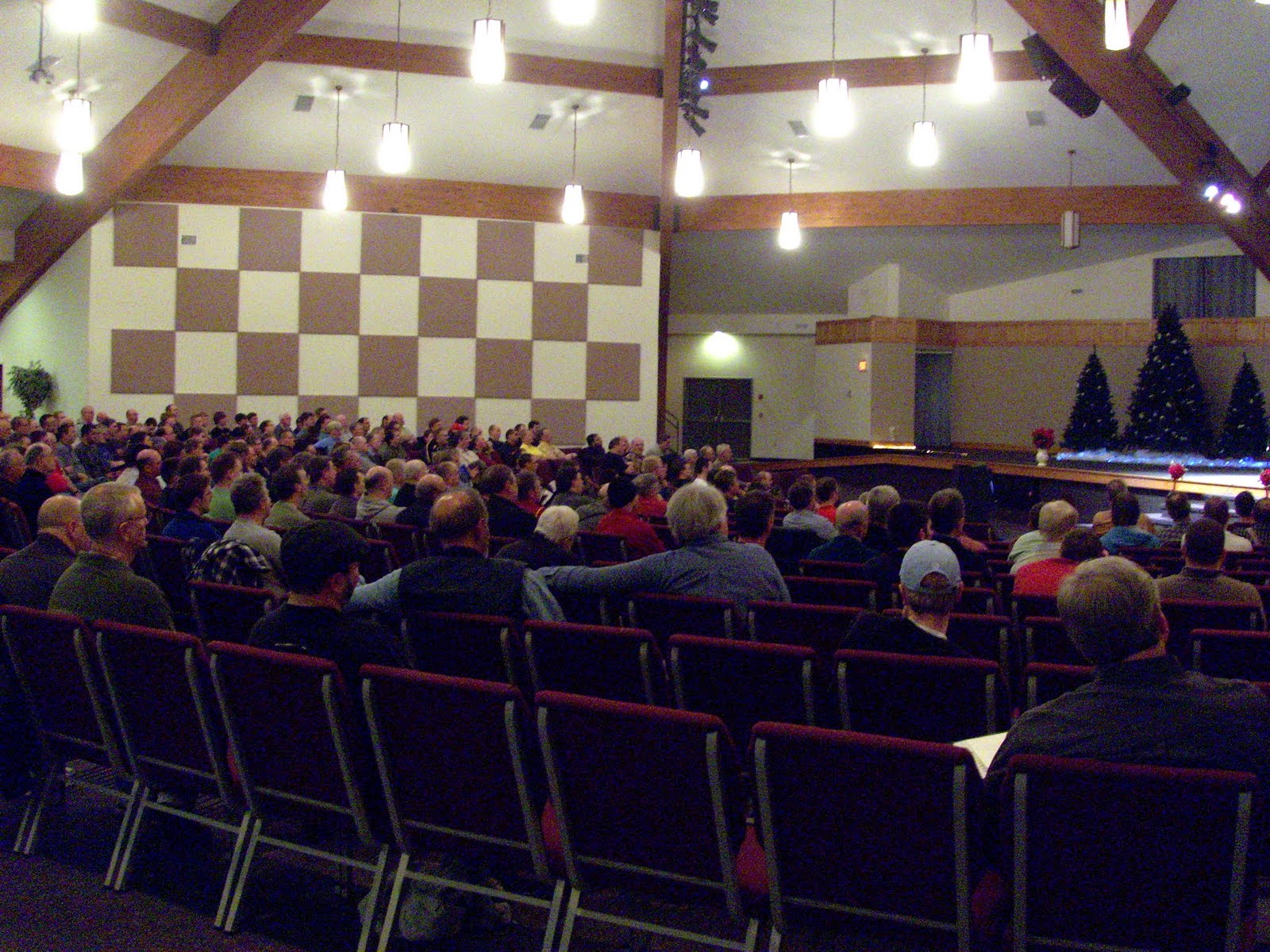
The Real Men Conference was held at Rising Sun Church of Christ on Friday night, February 18, 2011. 230 men came from all over the state of Iowa. 45 different Iowa communities were represented. It was an incredible encouragement to the men who came.

Pathway Band (from Pathway Church in Johnston, IA) led the worship experience. Hearing the room filled with men lifting their voices in praise to God was an incredible experience!

Jan Mickelson (from WHO Radio) spoke to the men about their relationship to the Lord as the primary factor in helping them become “Real Men” who will appropriately love their wives. It was a tremendous message that spoke straight into many of the men’s hearts

We watched the video testimony of Austen Arnaud (former quarterback for Iowa State) who shared the unique struggles and challenges of being a Christian athlete in an arena that is largely not Christian.

We also heard from Fred Stoeker (author of Every Man’s Battle) who shared his testimony. Although Fred went a little long, his message was a tremendously practical message calling men to live pure lives for the Lord and for the sake of the next generation.

Since the conference I have heard from a number of men who were impacted by the experience. Here’s a few examples:

“I just wanted to thank you for sponsoring the Real Men Conference last night. I thought it was a blessed and successful event. God also helped me to leave a bunch of garbage at the altar. Thank you again. I can’t wait for the next one!” -Stewart

“Awesome job on the Real Men 2011 -- I counted at least 15 of my guys there, which means you helped impact the families in our church in a very positive Godly way -- THANKS!” –Dan Hudson, Pathway Church

There have been more examples like these but I just wanted you to see a sampling. I am convinced that men are hungry for truth in this dark culture. Men need encouragement to be men. Men want to be called out to a higher standard than that of the world that says a real man drinks a lot of beer and ogles a lot of women. But a Real Man of God knows better.

That is why this conference is so important. I am so proud of Kyle Phillips who God laid the idea on his heart. He listened to God and now, as a result, many, many men’s lives have been impacted. Kyle Phillips is a Real Man!

Tuesday, February 8, 2011

Jan Mickelson, aka Jedi Master...

Maybe you saw the video of Zach Wahls giving his testimony speaking before a House Subcommittee on the marriage debate. If not here it is...


It was very well worded and presented. On Jan Mickelson's radio show today he masterfully "Reverse engineered" Zach's speech by deconstructing his arguments line by line. Here is the LINK to Jan's Blog on this. By the way, Jan Mickelson not only proves that he truly is the Jedi Master in this, he also happens to be one of the keynote speakers for our upcoming Real Men Conference on February 18, 2011 at Rising Sun Church of Christ. Register today at realmeniowa today!